In this post

Every cup of ceremonial cacao begins as a seed inside a pod on a tree. Between that pod and the deep, glossy paste you melt into your mug, there are days of patient work: picking, fermenting, drying, roasting and pressing. Each step shapes how your cacao tastes, and some steps change the natural compounds that make cacao so loved.
So how is ceremonial cacao made? Here is the journey from pod to paste, told through what researchers have learned about each stage, and how our own cacao from Tarapoto, San Martín, in Peru makes that journey.
1. The pod: hand-picked from the tree
Cacao pods grow straight from the trunk and branches of the Theobroma cacao tree. Inside each pod, the seeds sit wrapped in a soft, sugary pulp [1]. Those seeds are what we call cacao beans.
Harvesting is still mostly done by hand. The International Cocoa Organization (ICCO) describes pods being harvested manually, cut cleanly through the stalk with a sharp blade, and then opened to remove the beans within a week to ten days of harvest [6]. Smallholder farmers generally do this work by hand [6].
Our cacao is hand-picked. It is Criollo, the world's original cacao bean strain, traced back 2,000 years, and it grows wild in the Amazonian region of Tarapoto. Picking by hand means each pod is chosen when it is ready, and the beans inside are handled with care from the very first moment.
2. Fermentation: where flavour begins
The chocolate flavour we love begins to form during fermentation, a natural process driven by microbes living on and around the beans.
The beans and their pulp are piled together or placed in a box, often covered with banana leaves [6]. Then a natural succession of microbes gets to work: yeasts, lactic acid bacteria and acetic acid bacteria, all feeding on the sugary pulp [1, 2], with yeasts leading the first phase [3]. As they work, the pile warms up. Temperatures can reach up to 50°C [1].
That warmth, together with the ethanol, lactic acid and acetic acid the microbes produce, does something remarkable. It moves into the beans and ends the life of the seed, which sets off a cascade of changes inside it. These conditions trigger the production of flavour precursors: the building blocks that later become chocolate aroma [1]. A detailed 2019 review of chocolate chemistry explains that acids move into the beans and lower their pH, breaking down storage cells and releasing compounds derived from free amino acids, along with reducing sugars that are central to aroma development [3]. The same review notes that fermentation also reduces bitterness and astringency and deepens the beans' brown colour [3].
Researchers describe fermentation as stimulating both colour and flavour development in cocoa beans [2]. How long it lasts depends on the bean. According to the ICCO, Forastero beans need about five days of fermentation, while Criollo beans need only two to three [6].
Our beans are fermented after picking, beginning the slow transformation from seed to cacao.
3. Sun and air: roasting and drying
After fermentation, the beans are full of moisture and still changing. Drying brings that moisture right down so the beans are stable and can be stored and transported. The ICCO describes two methods, sun drying and artificial drying, and explains that drying reduces the beans' moisture from about 60% to about 7.5% [6]. A 2019 review reports a similar result, with dried cocoa beans holding 6–8% moisture [3]. Drying is also a time of quiet change: new aroma compounds form alongside the brown colour [3], and the volatile acids built up during fermentation are reduced through drying and roasting [3].
Roasting is where much of the familiar chocolate aroma is born. During roasting, the flavour precursors created in fermentation react in what is known as the Maillard reaction, and through these reactions cocoa gains its specific chocolate aroma and flavour [3]. In large-scale chocolate making, roasting is usually carried out at temperatures between 120 and 140°C [3]. Roasting can also change cacao's natural compounds: reductions in total polyphenol content during roasting have been observed in numerous studies [3]. In one study comparing cocoa beans from several regions of the world, a higher content of total polyphenols was found in unroasted beans, and every roasted sample showed lower antioxidant activity in the laboratory test used [4].
The ICCO notes there is no single correct roast, and every producer approaches it differently [7]. Our beans are sun-roasted and air-dried, a slow, natural process guided by the warmth of the Peruvian sun and the movement of fresh air. It is one of the reasons we feel our cacao carries the spirit of the place it comes from.
4. From nib to paste
Once dried and roasted, the beans are cracked and their thin shells are separated from the inner pieces, called nibs. The ICCO describes this stage as winnowing [7]. The nibs are then ground. Because cocoa beans are naturally rich in fat, containing 50–58% fats [3], grinding turns the solid nibs into a flowing mass known as cocoa liquor, or cocoa mass [3]. It contains no alcohol at all. It is simply the whole bean, ground until its natural fat, called cacao butter, melts and carries everything with it.
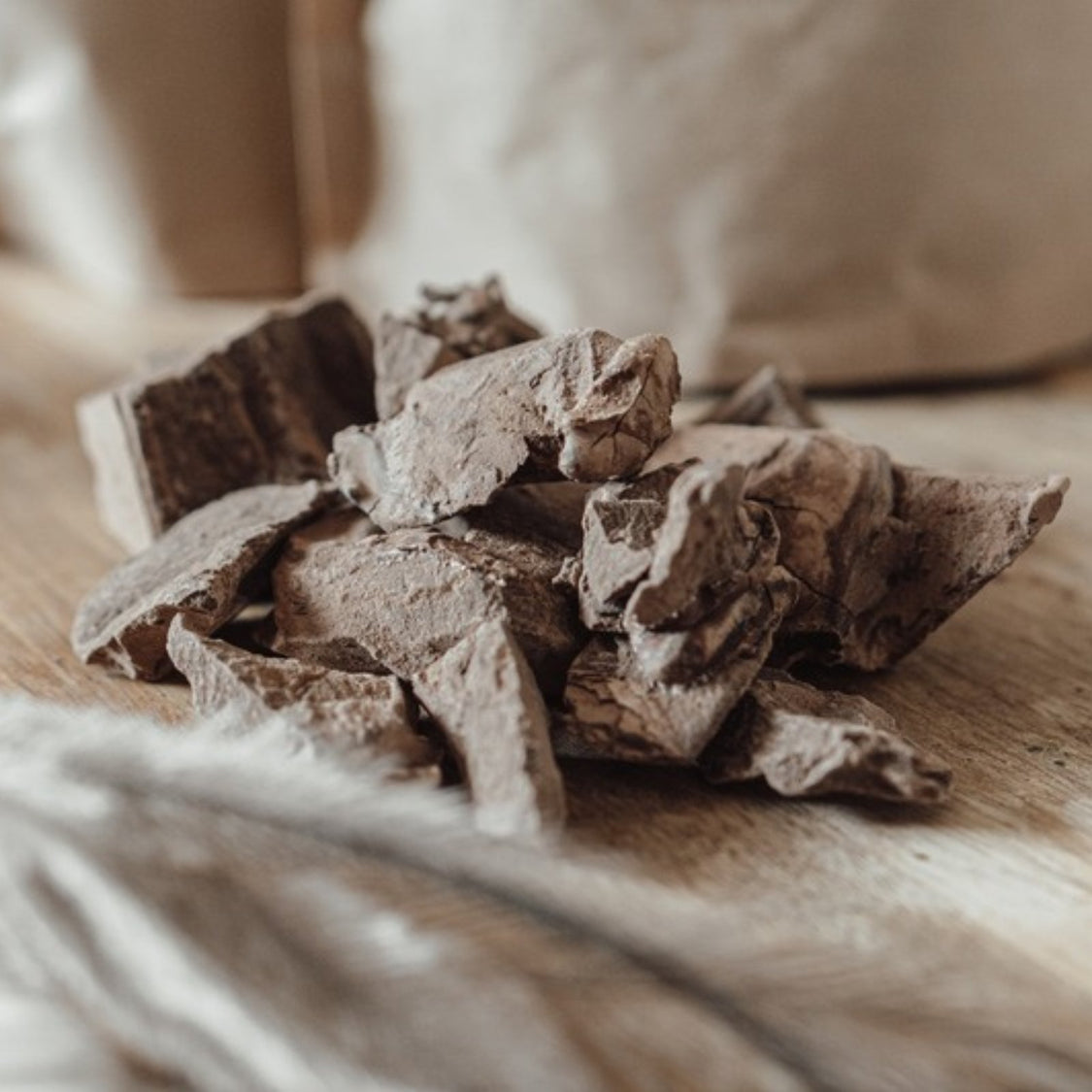
When that liquor cools and sets, you have pure cacao paste. This is ceremonial cacao in its most honest form: one ingredient, the whole bean, nothing taken away.
5. Pressing: the fork in the road
Here, the path of ceremonial cacao and the path of cocoa powder divide.
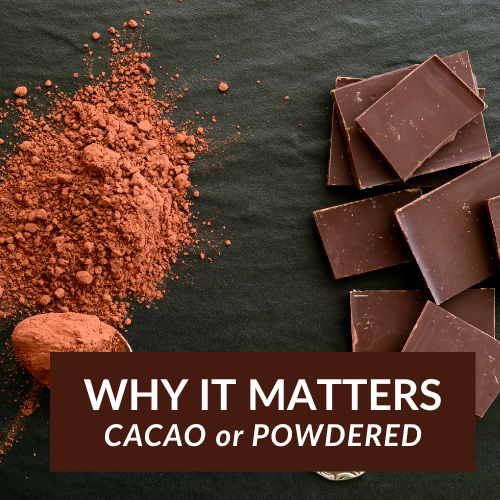
To make cocoa powder, the liquor is put under great pressure in a hydraulic press, which separates it into two products: cocoa butter and a dry cocoa cake [7]. That cake is broken and milled into powder [7]. Many powders are then alkalised, a treatment also known as Dutch processing, which uses alkaline compounds such as potassium carbonate and can shift the powder's colour anywhere from light red to charcoal black [7].
That extra step makes a real difference to cacao's natural compounds. A study from the University of Barcelona compared cocoa powders made in different ways and found that alkalisation caused a 60% loss of the mean total flavonoid content, with epicatechin, one of cacao's best-studied flavanols, falling by 67% on average [5]. If you would like to explore the wider differences, our guide to ceremonial cacao vs cacao powder goes deeper.
Our cacao is cold-pressed into paste and keeps all of its natural cacao butter. You can see it on the nutrition panel of every pack: about 51g of fat per 100g, right in line with the natural fat of the bean itself [3]. That richness is what gives a cup of ceremonial cacao its velvety body and slow, grounding warmth.
Why each step matters
Fermentation, drying and roasting each leave their mark on flavour [1, 3], and the bean itself matters too. No single step makes great cacao. It is the care taken at every one of them, from the first cut of the stalk to the final pressing.
This is also why ceremonial cacao feels so different from the chocolate most of us grew up with. Ceremonial cacao keeps the whole bean together, so you taste the bean itself, its origin and the hands that cared for it.
Our process, from Tarapoto to your cup
Here is how our cacao makes its journey:
- Hand-picked from wild-grown Criollo trees in the Amazonian region of Tarapoto, San Martín, Peru.
- Fermented to awaken the flavour hidden inside each bean.
- Sun-roasted by the warmth of the Peruvian sun.
- Air-dried slowly, until the beans are ready for their final step.
- Cold-pressed into pure paste that keeps its natural cacao butter.
Every batch is then lab tested in Australia before it reaches you. If you would like to learn more about the land our cacao comes from, read about cacao's rich history in Tarapoto.
A few words, decoded
- Cacao bean: the seed of the cacao pod, once it has been fermented and dried.
- Nib: the broken inner piece of the bean, after the thin shell is removed.
- Cocoa liquor or cocoa mass: nibs ground into a flowing paste. No alcohol, just the whole bean.
- Cacao butter: the natural fat of the bean, which gives ceremonial cacao its silky texture.
- Cocoa powder: what remains when most of the butter is pressed out and the dry cake is milled.
Caring for it at home
All of that care can continue in your kitchen. Treat your cacao gently and it will reward you. Measure 20g for an everyday cup, or 40–60g when you are sitting in ceremony. Pour over 150–200ml of water or mylk heated to 70–80°C: hot, but never boiling, because boiling water changes the flavour, and not for the better. Whisk or froth for thirty seconds or more, until the cup turns glossy and one deep chocolate colour. Enjoy it in the morning or early afternoon, when its gentle warmth can carry you through the day.
For a step-by-step guide, read how to drink ceremonial cacao at home.
Bringing it home
The next time you whisk your cup, take a moment to picture its journey: the pod cut by hand, the beans warming under banana leaves, the sun and air, the slow pressing into paste. Every sip holds all of it.
Our ceremonial cacao comes as a solid block, which you can shave or chop, or in pre-chopped bags that melt straight into warm water or mylk. The 1kg bag makes fifty 20g cups, and orders over $120 ship free across Australia. New to cacao? The Cacao Starter Kit has everything you need for your first ritual.
From pod to paste to your cup, we hope you feel the care in every step.
References
- Schwan RF, Wheals AE. The microbiology of cocoa fermentation and its role in chocolate quality. Critical Reviews in Food Science and Nutrition. 2004;44(4):205–221. doi:10.1080/10408690490464104
- De Vuyst L, Weckx S. The cocoa bean fermentation process: from ecosystem analysis to starter culture development. Journal of Applied Microbiology. 2016;121(1):5–17. doi:10.1111/jam.13045
- Barišić V, Kopjar M, Jozinović A, Flanjak I, Ačkar Đ, Miličević B, Šubarić D, Jokić S, Babić J. The chemistry behind chocolate production. Molecules. 2019;24(17):3163. doi:10.3390/molecules24173163
- Urbańska B, Kowalska J. Comparison of the total polyphenol content and antioxidant activity of chocolate obtained from roasted and unroasted cocoa beans from different regions of the world. Antioxidants. 2019;8(8):283. doi:10.3390/antiox8080283 (Note: the beans studied were supplied by a Polish chocolate producer; the authors report no specific funding and no conflict of interest.)
- Andres-Lacueva C, Monagas M, Khan N, Izquierdo-Pulido M, Urpi-Sarda M, Permanyer J, Lamuela-Raventós RM. Flavanol and flavonol contents of cocoa powder products: influence of the manufacturing process. Journal of Agricultural and Food Chemistry. 2008;56(9):3111–3117. doi:10.1021/jf0728754
- International Cocoa Organization. Harvesting & post-harvest processing. ICCO. icco.org/harvesting-post-harvest-new
- International Cocoa Organization. Processing cocoa. ICCO. icco.org/processing-cocoa
A gentle note: ceremonial cacao is a whole food, naturally rich in theobromine. If you are pregnant, breastfeeding, or taking antidepressants (particularly MAOIs) or heart medication, please check with your doctor before drinking it.
A note from us: Our journal is shared for general education and inspiration. It is not medical advice, and nothing here is intended to diagnose, treat, cure or prevent any health condition. Research we mention is reported as research, not as a claim about our products. Everyone's body is different, so please speak with your doctor or a qualified health professional before changing your diet, especially if you are pregnant, breastfeeding, taking medication or managing a health condition.