In this post
- What is theobromine?
- How much theobromine is in a cup of ceremonial cacao?
- How theobromine works in the body
- What the research says about mood and alertness
- The balance of theobromine and caffeine
- Why a cup of cacao feels different from coffee
- A note for animal lovers
- Enjoying theobromine mindfully
- Bringing it home
- References
Ask people how a cup of ceremonial cacao feels and you will often hear the same words: warm, steady, clear, open. Not the quick lift and drop of a strong coffee, but something slower and softer. Much of that difference comes down to one natural compound that cacao holds in abundance: theobromine.
So what is theobromine, how much is in your cup, and what does the research actually say about it? Here is a calm, clear guide to the gentle compound at the heart of cacao.
What is theobromine?
Theobromine belongs to a family of natural compounds called methylxanthines. Its best-known relative is caffeine, and the two are close cousins in structure. Both are found in the cacao bean, but theobromine is present in much higher amounts than caffeine, and researchers believe it sits behind several of the effects people attribute to cocoa [1].
Its name comes from the cacao tree itself, Theobroma cacao. Theobroma is often translated from Greek as "food of the gods", and despite the "bromine" in its name, theobromine contains no bromine at all. It is simply named after the tree that makes it.
There is a lovely connection between theobromine and caffeine, too. When your liver breaks down caffeine, one of the compounds it produces is theobromine [1]. So even coffee drinkers meet a little theobromine along the way.
If you would like the wider picture of everything else in the bean, from flavanols to minerals, our guide to the key natural compounds in ceremonial cacao covers them all. This post focuses on theobromine alone.
How much theobromine is in a cup of ceremonial cacao?
Every harvest is a little different, so the exact amount varies from bean to bean and batch to batch. But we can get a good sense of it from the United States Department of Agriculture's food composition database, which lists unsweetened baking chocolate, a product that is also 100% cacao, at about 1,300mg of theobromine and 80mg of caffeine per 100g [4]. It holds about 52g of fat per 100g [4], very close to the natural cacao butter in our own paste.
Using those reference figures as a guide, an everyday 20g cup of pure cacao would carry roughly 260mg of theobromine and around 16mg of caffeine. A ceremonial serve of 40–60g would carry two to three times as much. Please treat these as estimates rather than measurements of any one batch.
For comparison, Australia's food regulator, FSANZ, describes about 240mg of caffeine as roughly three cups of instant coffee [6], which works out to around 80mg a cup. So a 20g cup of cacao holds a small fraction of the caffeine in a cup of instant coffee, alongside a generous amount of theobromine.
You may notice that cocoa powder is listed even higher, at about 2,060mg of theobromine per 100g [4]. That is because most of the cacao butter has been pressed out of powder, which concentrates what is left. Whole cacao paste keeps its butter, so it carries everything the bean holds, in the balance the bean holds it.
How theobromine works in the body
Theobromine and caffeine work in similar ways. Both block adenosine receptors, the docking points for adenosine, one of the body's natural messenger molecules. Both also inhibit enzymes called phosphodiesterases [1]. These are the main ways methylxanthines exert their effects.
The difference is in the detail. Theobromine is less active at these receptors than caffeine, and caffeine passes from the blood into the brain more readily than theobromine does [3]. Theobromine also moves through the body at its own, slower pace:
- It arrives slowly. Caffeine peaks in the blood about 30–40 minutes after you drink it, while theobromine takes about 2–3 hours to reach its peak [3].
- It stays longer. In a study of healthy volunteers, the half-life of theobromine, the time it takes the body to clear half of it, was 7.2 hours, compared with 4.1 hours for caffeine [2].
That slow rise and long, gentle tail is a big part of why cacao is so often described as steady rather than sharp. It is also why we suggest enjoying your cacao in the morning or early afternoon, so it can carry you through the day and leave your evening free to settle.
What the research says about mood and alertness
Researchers have been curious for a long time about why chocolate is so loved. A 2015 review from the University of Navarra and the University of Barcelona concluded that theobromine and caffeine, in the proportions found in cocoa, are responsible for the liking of the food or drink, and that these compounds influence mood and alertness in a positive way [1].
The most thorough study of theobromine on its own was a placebo-controlled trial at the University of Chicago. Eighty healthy adults, all light caffeine users, took capsules of theobromine at 250mg, 500mg or 1,000mg, or 200mg of caffeine for comparison, in separate sessions [3]. Here is what the researchers found:
- At 250mg, theobromine had limited effects, though people did report wanting more of it [3].
- At higher doses, the effects on mood became negative, and heart rate rose as the dose went up [3].
- The authors concluded that theobromine at normal intake levels may contribute to the positive effects of chocolate, but that at higher intakes the effects become negative [3].
Two things are worth knowing about this study. First, it tested theobromine capsules on their own, not a cup of cacao, which brings theobromine together with caffeine, cacao butter and everything else in the bean. Second, it was supported by Unilever R&D as well as US National Institutes of Health grants [3].
The gentle takeaway is a familiar one: with cacao, more is not always better. The same researchers note that a 40g bar of dark chocolate holds about 200–300mg of theobromine, which they describe as normal intake [3], and an everyday 20g cup of pure cacao sits in that range. Larger ceremonial serves are something to build up to slowly, listening to how your own body responds.
The balance of theobromine and caffeine
Cacao never offers theobromine alone. It always arrives with a little caffeine, and the balance between the two differs from one type of cacao to another. In fact, it differs enough that researchers use the ratio of theobromine to caffeine as one of the clues for telling cacao varieties apart.
A 2026 study of cacao from the Brazilian Amazon described a theobromine-to-caffeine ratio of about 1.8 as consistent with values typically seen in Criollo cacao, compared with about 4.7 for beans more typical of Trinitario [5]. In other words, Criollo tends to carry a little more caffeine alongside its theobromine than some other types.
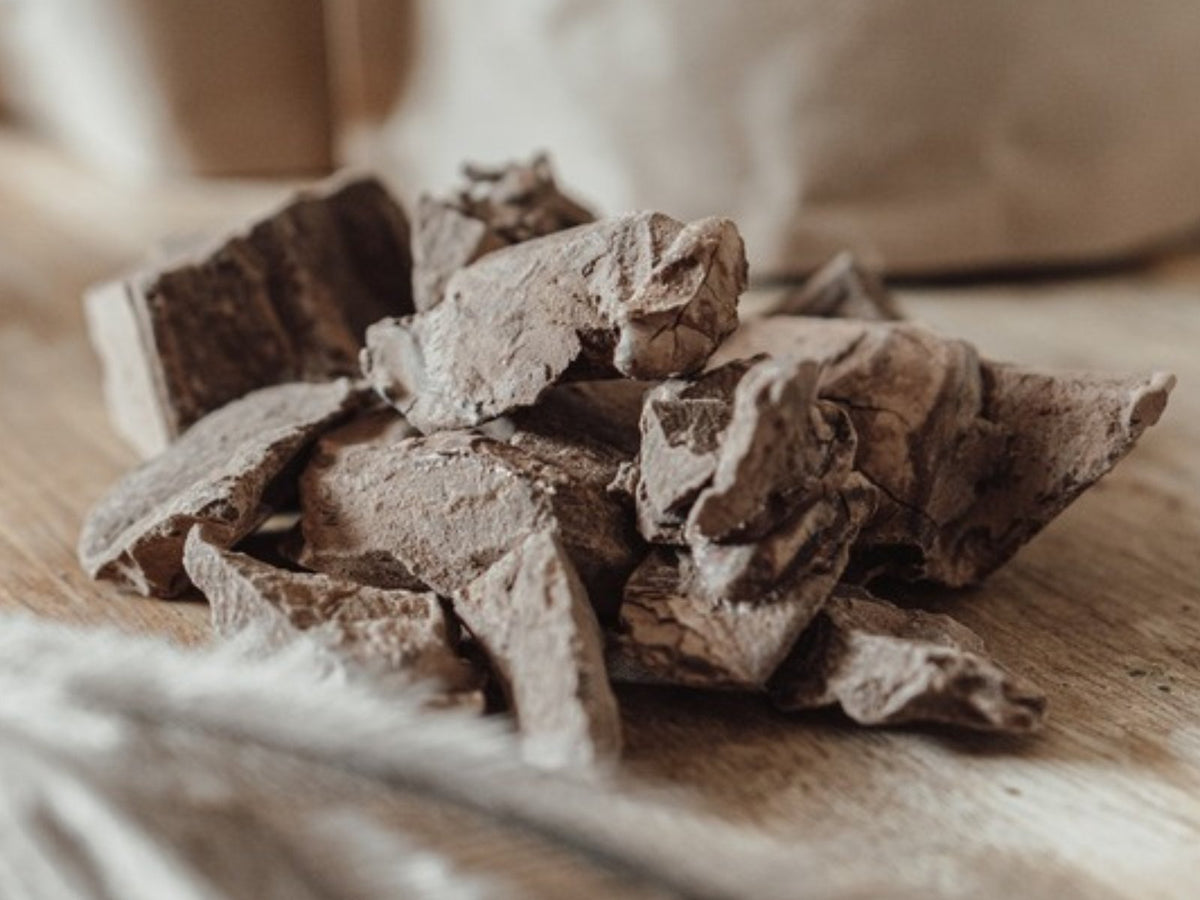
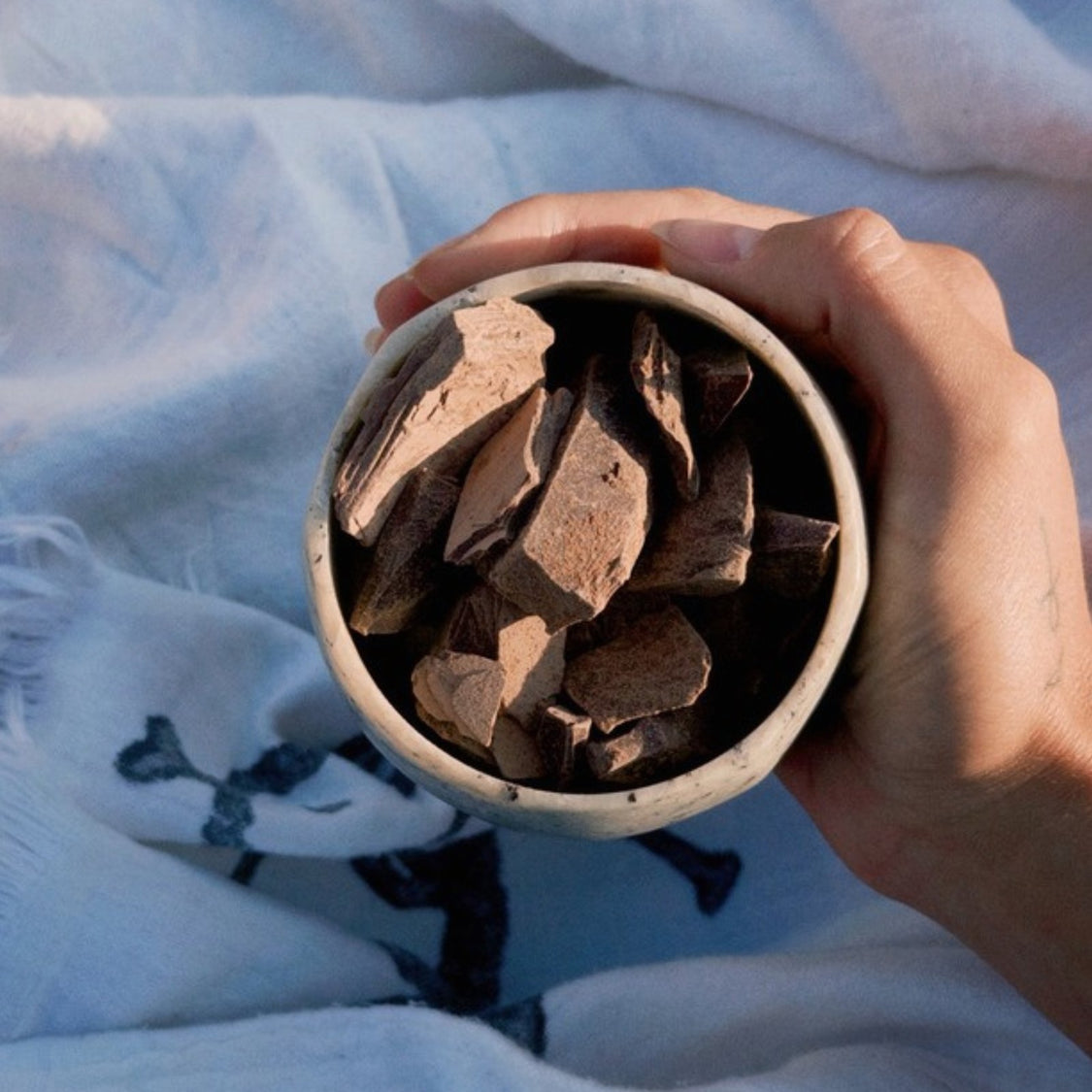
Our cacao is Criollo, the world's original cacao bean strain, traced back 2,000 years. It grows wild in the Amazonian region of Tarapoto, San Martín, in Peru, where it is hand-picked, fermented, sun-roasted, air-dried and cold-pressed into pure paste, then lab tested in Australia. Every cup carries the natural balance of compounds that this ancient bean was made with.
Why a cup of cacao feels different from coffee
Put all of this together and the gentle character of cacao starts to make sense. Compared with a cup of instant coffee, an everyday cup of cacao carries only a small amount of caffeine [4, 6]. Most of its methylxanthine content is theobromine instead, a compound that is less active than caffeine at the same receptors and slower to reach the brain [3]. It takes hours rather than minutes to peak in the blood, and it lingers for longer once it is there [2, 3].
That is a very different shape from the quick rise of caffeine. Many people who come to cacao from coffee describe the experience as gentler and more grounded. Of course, everyone's body is different, and the only way to know how cacao feels for you is to sit with a cup, slowly, and notice.
It is also a lovely reminder that cacao is not trying to be coffee. It is its own ritual, with its own pace, and it asks you to slow down to meet it.
A note for animal lovers
Theobromine affects animals very differently. Researchers note that it appears to be toxic in some mammals, including pets [1]. So please keep your cacao, and any chocolate, well out of reach of your dog and other furry family members.
Enjoying theobromine mindfully
Here is how we like to work with cacao's gentle rhythm:
- Start with 20g. This is our everyday serve. Save 40–60g for ceremony, once you know how cacao feels for you.
- Enjoy it in the morning or early afternoon. Theobromine rises slowly and lingers, so an earlier cup suits its natural pace.
- Prepare it gently. Pour 150–200ml of water or mylk at 70–80°C over your cacao. Hot, but never boiling. Whisk or froth for thirty seconds or more, until it turns glossy and one deep chocolate colour. Our how to brew guide walks you through it.
- Sip slowly. Theobromine is not in a hurry, and neither are you. Let the cup be a pause in your day: a reset in a mug.
If you are wondering how much is right for you, our guide to getting the right cacao dose goes into more depth, and our post on cacao vs coffee beans explores how the two compare.
Bringing it home
Theobromine is a quiet compound. It does not rush in or demand attention. It arrives slowly, stays a while and leaves gently, which feels very much like the spirit of cacao itself.
Explore our ceremonial cacao, available as a solid block or in pre-chopped bags that melt straight into your cup. The 1kg bag makes fifty 20g cups, and orders over $120 ship free across Australia. New to cacao? The Cacao Starter Kit has everything you need for your first ritual.
References
- Martínez-Pinilla E, Oñatibia-Astibia A, Franco R. The relevance of theobromine for the beneficial effects of cocoa consumption. Frontiers in Pharmacology. 2015;6:30. doi:10.3389/fphar.2015.00030 (The authors declare no commercial or financial conflict of interest.)
- Lelo A, Birkett DJ, Robson RA, Miners JO. Comparative pharmacokinetics of caffeine and its primary demethylated metabolites paraxanthine, theobromine and theophylline in man. British Journal of Clinical Pharmacology. 1986;22(2):177–182. doi:10.1111/j.1365-2125.1986.tb05246.x (free full text)
- Baggott MJ, Childs E, Hart AB, de Bruin E, Palmer AA, Wilkinson JE, de Wit H. Psychopharmacology of theobromine in healthy volunteers. Psychopharmacology. 2013;228(1):109–118. doi:10.1007/s00213-013-3021-0 (free full text). Funding: Unilever R&D, with additional US National Institutes of Health grants.
- U.S. Department of Agriculture, Agricultural Research Service. FoodData Central (SR Legacy): Baking chocolate, unsweetened, squares (FDC ID 167568); Cocoa, dry powder, unsweetened (FDC ID 169593). fdc.nal.usda.gov (search by FDC ID)
- Silva DAE, de Lima CLS, Lima GVS, Silva AMM, da Silva NC, Rogez HLG, de Souza JNS. Phenotypic, physicochemical, sensory, and functional attributes of cocoa (Theobroma cacao L.) from Brazilian Amazonian floodplain and upland ecosystems. Journal of the Science of Food and Agriculture. 2026;106(13):7775–7783. doi:10.1002/jsfa.70793 (free full text)
- Food Standards Australia New Zealand. Caffeine. FSANZ. foodstandards.gov.au
A gentle note: ceremonial cacao is a whole food, naturally rich in theobromine. If you are pregnant, breastfeeding, or taking antidepressants (particularly MAOIs) or heart medication, please check with your doctor before drinking it.
A note from us: Our journal is shared for general education and inspiration. It is not medical advice, and nothing here is intended to diagnose, treat, cure or prevent any health condition. Research we mention is reported as research, not as a claim about our products. Everyone's body is different, so please speak with your doctor or a qualified health professional before changing your diet, especially if you are pregnant, breastfeeding, taking medication or managing a health condition.